
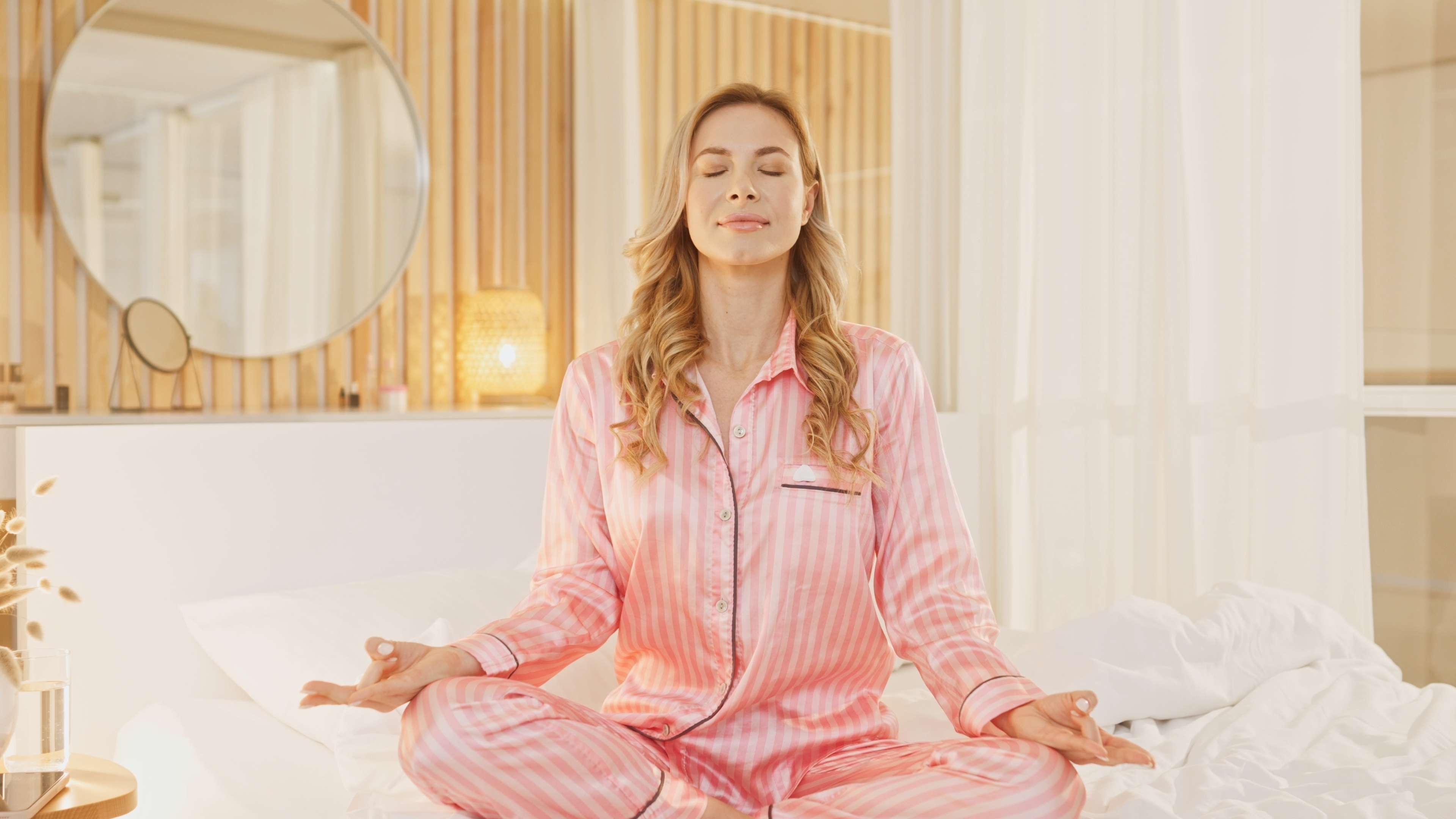
It is the most frustrating paradox: you are exhausted, but the moment your head hits the pillow, your mind turns on. You’re suddenly hit with a highlight reel of your day, a detailed "to-do" list for tomorrow, or a random cringe-worthy memory. You're tired, yet wired. The more you try to force sleep, the more it slips away. In such instances, Meditation for sleep offers a gentle, effective alternative.
It's not about forcing sleep, but about creating the conditions for sleep by quieting the mind and calming the body.
That "wired" feeling is a hyper-active nervous system. You're stuck in "fight-or-flight" mode, and your brain has not yet received the indication that it's safe to power down. The "effort" of trying to sleep is a form of stress, which only makes the problem worse.
Meditation helps by:
Anchoring your mind: It gives your "monkey mind" a simple, non-stressful job to do, preventing it from spiraling into anxious thought loops.
Calming your body: It actively triggers your parasympathetic "rest-and-digest" nervous system, slowing your heart rate and relaxing your muscles.
You don't need to sit on the floor to practice meditation for sleep. Get in your bed, turn off the lights, and get comfortable.
This is the most effective meditation for sleep. It works by systematically shifting your attention from your thoughts to your body.
Start at Your Toes: Close your eyes and bring your full, gentle attention to the toes on your left foot. Don't wiggle them; just feel them. Notice any sensations: warmth, coolness, tingling, the pressure of the blanket.
Move Up Slowly: After 15-20 seconds, move your attention to the sole of your foot. Then your heel. Then your ankle.
Continue Up Your Body: Slowly, patiently, move your awareness up your left leg (calf, knee, thigh), and then repeat on your right. Move through your pelvis, your stomach, your lower back, your chest, your fingers, your arms, your shoulders, your neck, and finally, your face.
The purpose of this sleep meditation practice is ‘Just to Feel’. If your mind wanders, that's fine. Just gently bring it back to the part of the body you were on.
Most people fall asleep before they even get to their knees. You are lulling your mind into a state of deep, non-verbal rest, making it incredibly easy to drift off.
If your mind is too active for the Body Scan, give it a simple, pleasant picture to focus on.
Create Your Place: In your mind's eye, picture a place where you feel completely safe and at peace. This could be a warm, sandy beach, a quiet forest cabin, or a cozy room with a fireplace.
Engage All Your Senses: Make the image real. What do you see? (The color of the water, the leaves on the trees.) What do you hear? (Gentle waves, a crackling fire.) What do you smell? (Salt air, pine.) What do you feel? (The warm sand, a soft blanket.)
Rest in that Space: Your only purpose is to simply "be" in this peaceful place. Whenever your mind drifts to a real-world worry, gently acknowledge it and guide your attention back to the sights and sounds of your safe place.
A final, crucial tip: The goal of this meditation is not to fall asleep. The goal is simply to rest. This one mental shift removes all the pressure. If you "fail" at falling asleep, you still "succeeded" at resting your mind and body, which is a victory. Release the need to try. Just rest, and let sleep come to you.