
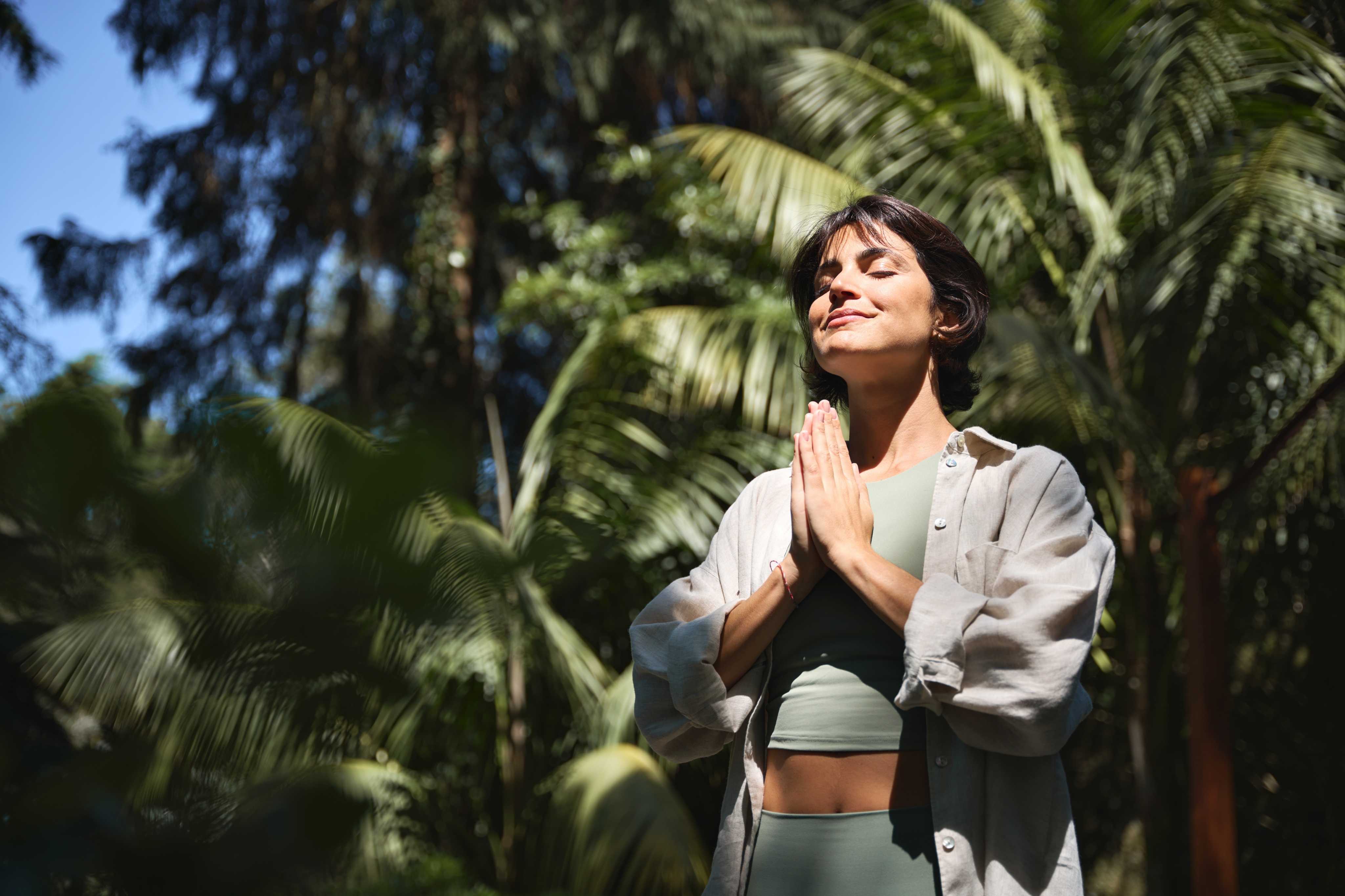
Your heart is pounding. Your chest feels tight. Your mind is a whirlwind of "what if" scenarios, and you can't seem to find the "off" switch. This is the grip of anxiety. It’s a biological state, a high-alert "fight-or-flight" response that has hijacked your nervous system. Meditation for anxiety and stress is one of the most powerful, science-backed tools to directly and biologically turn that alarm off. It is not just "relaxing" but it is a technique for actively reclaiming your own nervous system.
Let’s dive deeper and explore the best meditation practices for anxiety and stress.
Before you learn the meditation practices to eliminate stress, it is first necessary to learn how it impacts your state of mind during the fight or flight scenarios.
The Anxious State:
Your sympathetic nervous system (the "gas pedal") is stuck on. Your amygdala (the brain's alarm) is hyperactive, flooding you with stress hormones like cortisol and adrenaline. Your body is ready to run from a tiger, even if you're just sitting at your desk.
The Meditative State:
Meditation activates your parasympathetic nervous system (the "brake pedal"). It strengthens the prefrontal cortex (the logical "adult" part of your brain), which in turn helps to calm the amygdala. You are, quite literally, telling your body, "You are safe. Stand down."
You can do this right now, in your chair.
Anxiety lives in your thoughts, in the future. The first step is to anchor your mind in the present, physical moment.
Feel Your Feet: Start by planting both feet flat on the floor. Wiggle your toes. Really feel the solid ground beneath you.
Feel Your Seat: Notice the pressure of your body on the chair. Feel the texture of your clothes on your skin.
Look Around (The 5-4-3-2-1 Method): If closing your eyes makes you more anxious, keep them open. Softly name 5 things you can see in the room. Then, name 4 things you can feel. Name 3 things you can hear. Name 2 things you can smell. Name 1 thing you can taste. This is a powerful technique that pulls your mind out of the abstract spiral of worry and into a concrete, "right now" reality.
Your breath is a remote control for your nervous system and a critical tool in this meditation practice. By simply making your exhale longer than your inhale, you manually trigger your "rest-and-digest" response.
Inhale gently through your nose for a count of 4.
Exhale slowly, as if through a straw, for a count of 6.
Repeat this 5-10 times. You will feel your heart rate begin to slow down. This is a real, biological shift.
The worst thing you can do to an anxious thought is try to fight it. What you resist, persists. Instead, you will become a neutral observer.
As you continue to breathe, anxious thoughts will come. That’s okay.
When a "what if" thought pops up, simply and calmly label it in your mind: "Thinking."
If it's a "to-do" list, label it: "Planning."
If it's a worry, label it: "Worrying."
Don't get angry at the thought. Just label it, and then gently, compassionately, guide your attention back to your long exhale.
This practice, called "noting" or "labeling," creates a tiny bit of space between you and your thoughts. You are no longer in anxiety; you are observing the anxiety. This is where your power lies.
You are not your anxiety. You are the person experiencing it. Meditation for sleep is not a one-time cure; it is a valuable skill you can build for a peaceful living. It is the practice of learning to be the calm, steady anchor in your own storm. You have this tool. You can use it anytime, anywhere, and you can start right now, with this next breath.